Europe’s 28th regime: What is the new EU legal path for startups


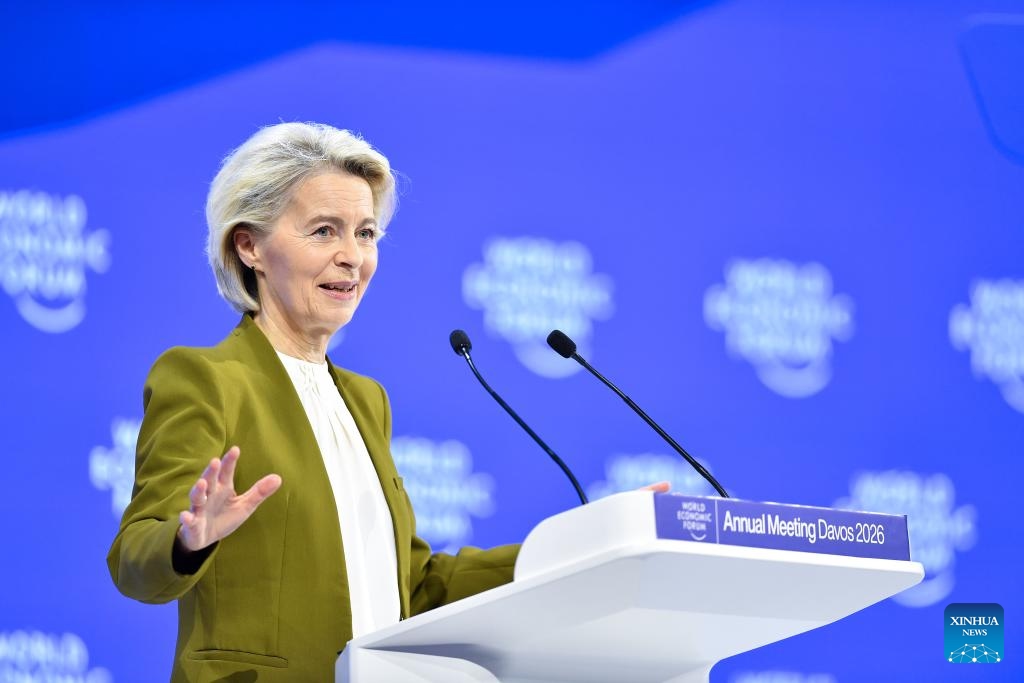
The European Union is moving to simplify how startups operate across borders with the launch of the “28th regime,” a new optional EU-wide corporate framework aimed at supporting innovation and scale-ups. Outlined by the European Commission in January 2026, the initiative is closely linked to EU-INC, a founder-led campaign advocating for a truly pan-European company structure (Tech).
This article explains what the 28th regime is, why it matters for European startups and early-stage founders, how EU-INC influenced the proposal, and what founders should expect next.
Key takeaways
- The 28th regime introduces a single EU-level legal company option for startups.
- It aims to reduce legal fragmentation, costs, and administrative delays.
- Company incorporation would be digital-first and significantly faster.
- EU-INC played a major role in pushing the proposal forward.
- The reform could reshape how startups scale across Europe.
Why Europe needs the 28th regime for startups
Europe is introducing the 28th regime to address one of the biggest barriers facing European startups: fragmented national company laws.
Today, startups expanding across Europe must navigate 27 different national company law systems, leading to:
- High legal and compliance costs, as founders must hire local legal expertise in each country.
- Slower market expansion, due to repeated incorporation and registration processes.
- Administrative complexity, including different reporting, governance, and documentation requirements.
- Inconsistent investor expectations, as legal structures vary by jurisdiction.
- Reduced founders focus on growth, with time and energy diverted to bureaucracy instead of product and customers.
According to DIGITALEUROPE, this fragmentation is a key reason many European startups struggle to scale within the EU. The organisation argues that Europe needs “European rules for European scale-ups” rather than a patchwork of national regimes.
What exactly is the EU’s 28th regime
The 28th regime is an optional EU-level legal form that startups can choose instead of incorporating separately in each member state.
In practical terms, it would allow founders to:
- Register a company once at EU level
- Operate across all EU member states under the same legal structure
- Avoid re-incorporation or complex legal duplication
The European Commission announced the initiative in January 2026 as part of a broader effort to strengthen innovation and scale-ups across Europe.
DIGITALEUROPE describes the goal as allowing founders to “focus on growth rather than bureaucracy,” a theme echoed by EU policymakers and ecosystem leaders.
What the 28th regime proposes
Under current proposals, incorporation under the 28th regime would be digital-by-default and significantly faster than existing national processes.
Key features discussed include:
- Fully online company registration
- Target incorporation timelines of around 48 hours
- Reduced administrative steps compared to national regimes
European Commission President Ursula von der Leyen highlighted speed and simplicity when unveiling the plan, stating that entrepreneurs should be able to “register a company anywhere in Europe, fully online, in a matter of days” (Tech).
What is the role of EU-INC in shaping the 28th regime
The EU-INC movement has been instrumental in pushing the proposal forward.
In a widely circulated explainer video, supporters note that it is often “easier for a European startup to expand to the US than to another EU country,” underscoring the inefficiencies of the current system (EU-INC YouTube, 2025).
EU-INC presents the 28th regime as a way to make the EU Single Market genuinely borderless for startups.
Watch the video below to better understand how legal fragmentation affects European founders and how the 28th regime could change that. The video is particularly useful for first-time founders navigating cross-border expansion.
What are the potential benefits and concerns of the 28th regime
Supporters believe the 28th regime could:
- Help Europe retain high-growth startups and companies
- Make the EU more attractive to global investors
- Strengthen the EU Single Market for innovation
Critics, however, raise concerns about:
- Possible impacts on national labour protections
- Reduced regulatory autonomy at member state level
These debates highlight that while the 28th regime is widely supported in the startup ecosystem, its final design will matter greatly for long-term impact.
For founders, the real impact of the 28th Regime will depend less on the legal form itself and more on whether investors, banks, and national authorities fully recognize and support it in practice.
Even a well-designed EU-wide structure will only succeed if it is broadly accepted by those who:
- fund startups,
- provide financial services,
- and enforce regulations at national level.
How Innokite supports European founders
Innokite supports early-stage startups as they prepare to scale across borders and navigate emerging opportunities within Europe.
As Europe moves toward a more unified startup ecosystem, founders need more than just regulatory reform. They also need:
- Practical guidance,
- Access to experienced mentors,
- A strong community, and
- Hands-on support to navigate this new landscape.
Innokite helps aspiring entrepreneurs and future founders as they navigate growth opportunities in Europe, including initiatives like the 28th regime.
Are you building a company with European ambition? Now it’s the time to act!
Join our incubator and be part of the next generation of startups shaping Europe’s future.
FAQs: Europe’s 28th regime
What is Europe’s 28th regime?
An optional EU-level company structure for operating across member states.
Is the 28th regime mandatory?
No. Founders can choose between national law and the EU framework.
Who is the 28th regime most relevant for?
Startups planning to scale or operate across multiple EU countries.
When could the regime take effect?
Announced in January 2026; rollout details are still evolving.
What should founders do now to prepare for the 28th regime?
Track policy developments, plan for future incorporation options, and seek ecosystem support through incubators such as Innokite.
News
.avif)